Overview
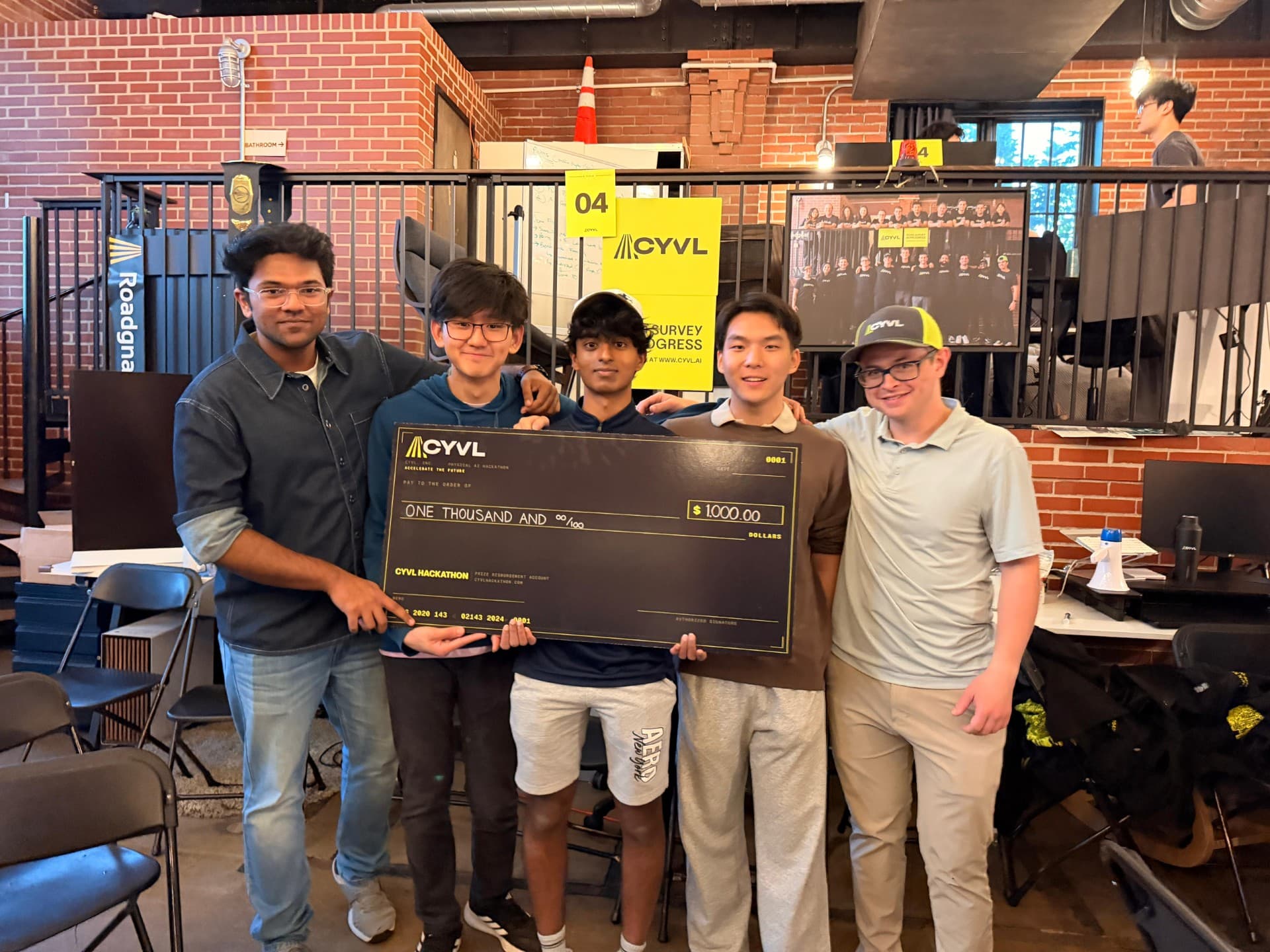
DeCYVLery Bots was a 3rd-place CYVL AI Hackathon startup pitch for autonomous sidewalk delivery robots trained inside city-scale digital twins generated from CYVL LiDAR data.
Startup pitch and reinforcement-learning simulation prototype for autonomous sidewalk delivery robots trained in digital twins built from CYVL LiDAR street data.
Project Summary
A short look at the build, the main technical choices, and the pieces I iterated along the way.
DeCYVLery Bots was a 3rd-place CYVL AI Hackathon startup pitch for autonomous sidewalk delivery robots trained inside city-scale digital twins generated from CYVL LiDAR data.
I took a specific chunk of a Boston street, simulated pedestrians as moving pill-shaped agents, and trained RSL-RL navigation policies on cloud A100 compute.
The design process compared four policy iterations across training length and observation stack: undertrained baseline, camera-only, camera + LiDAR, and a final LiDAR-only policy.
Design Process
The final policy is shown first, followed by the training iterations that shaped the sensing stack and reward behavior.
The strongest policy removed the camera and relied on LiDAR-style observations plus GPS-style current and target coordinates for direction.
The first training run established the simulation setup but did not train long enough to converge.
The second policy trained longer and used a camera mounted on top of the robot, but camera-only observations could not accurately gauge depth in the street scene.
Adding LiDAR improved navigation stability and reduced sidewalk-edge failures, but the camera + LiDAR policy was particularly cautious around people.